How To Search for Peoria Property Records

Property records are an invaluable resource for homebuyers, investors, and real estate professionals looking to conduct thorough due diligence and make well-informed decisions. These records provide a wealth of information, including ownership history, parcel boundaries, assessed valuations, tax statuses, zoning designations, building features and characteristics, permitted uses, site amenities, liens, notice of trustee sales, and more. In Peoria, property records are public records, meaning they are generally accessible to anyone interested in viewing or obtaining copies. However, identifying the correct starting point is critical to a successful search, especially considering that Peoria spans two counties: most of the city lies in Maricopa County, with a small northern portion extending into Yavapai County. Below is a list of key resources that you can use to find different types of Peoria property records.
Peoria City Resources

Peoria is a dual-county city, primarily in Maricopa County but with a small extension into Yavapai County. Because of this, it is essential to verify which county the property you are interested in is located. The City of Peoria provides various GIS Maps on its official website that you can use to look up and verify addresses within the city limits, view parcel details, confirm zoning classifications and land use restrictions, locate city utilities and infrastructure, and much more.
County Recorder's Offices

Peoria spans two counties: Maricopa and Yavapai. The Maricopa County and Yavapai County recorder's offices serve as primary custodians of deeds, deeds of trust, liens, plats, and other documents that establish ownership and transfers of properties located within their respective boundaries. Both offices provide searchable online tools that you can use to look up documents by owner name, parcel number, or recording date. Please note that search options and document availability may differ between the two counties. You can also visit the appropriate county recorder's office to access records and for other in-person services. Here are the contact details and links to the online search tools for the Maricopa and Yavapai Counties' Recorder's Offices:
-
Maricopa County Recorder:
301 W Jefferson St., 2nd Floor, Suite 200
Phoenix, AZ 85003
Phone: (602) 506-3535
-
Yavapai County Recorder:
1015 Fair Street, 2nd Floor
Prescott, AZ 86305
Phone: (928) 771-3244 (option 6)
County Assessor's Offices

The Maricopa County and Yavapai County Assessors are responsible for identifying, listing, describing, and valuing real property in Peoria for tax purposes (note: each office only covers properties located within its respective county boundaries). The assessor's offices are key resources for information on property ownership, valuation, characteristics, sales history, and more. Both offices provide search tools that you can use to look up this information online; searches are typically conducted by name, address, or property ID, though specifics may vary by county. You can also visit the appropriate assessor's office to search records in person or for general assistance. Here are the contact details and links to the online search tools for the Maricopa and Yavapai Counties' Assessor's Offices:
-
Maricopa County Assessor's Office:
301 W Jefferson Street
Phoenix, AZ 85003
Phone: (602) 506-3406
-
Yavapai County Assessor's Office:
1015 Fair Street, 1st Floor
Prescott, AZ 86305
Phone: (928) 771-3220
County Treasurer's Offices

The Maricopa County Treasurer or the Yavapai County Treasurer manages property tax billing and collection in Peoria, depending on the property's location within the city. Both treasurer's offices provide online search tools that you can use to look up tax-related property records, including current tax statements, payment histories, outstanding balances, delinquent tax information, and tax lien information. You can also contact these offices directly to access records in person, for tax payment assistance, and other general inquiries. Here are the contact details and links to the online search tools for the Maricopa and Yavapai Counties' Treasurer's Offices:
-
Maricopa County Treasurer's Office:
301 W. Jefferson St., Suite 100
Phoenix, AZ 85003
Phone: (602) 506-8511
-
Yavapai County Treasurer's Office: 1015 Fair Street, 2nd Floor, Prescott, AZ 863055.
Phone: (928) 771-3233, Tax Inquiry.
County Courts

The Maricopa and Yavapai Courts (primarily the Superior and Justice Courts) are valuable resources for property records related to legal matters or disputes in Peoria. These include foreclosures, quiet title actions, landlord-tenant disputes, boundary disputes, code enforcement cases, partition actions, and probate disputes. Both counties offer online access to case records, and you can also contact the Clerk of the Superior Court for the county where the case was filed to view and request copies. Please note that fees may apply. Here are the addresses and contact numbers for the Maricopa and Yavapai Counties' superior court clerk's offices and links to each county's case records search tool:
-
Maricopa County Clerk of the Superior Court:
Central Court Complex, 201 W Jefferson St.
Phoenix, AZ 85003
Phone: (602) 372-5375
-
Yavapai County Clerk of Superior Court:
Yavapai County Courthouse, 120 South Cortez Street
Prescott, AZ 86303
Phone: (928) 771-3312
Peoria Property Taxes

Property taxes in Peoria are a vital funding source for various local government services, including police and fire protection, emergency response, public schools, libraries, parks and recreation, public roads and infrastructure, and community programs. The Maricopa and Yavapai County Assessors determine the taxable value of properties in the city, while the County Treasurers handle tax billing and collection. Properties are assessed annually, and two key values are established: a "Full Cash Value (FCV)," which is the property's estimated market value, and a "Limited Property Value (LPV)," which is the actual basis for property taxes. Under Arizona state law, a property's LPV can never exceed its FCV, and the LPV may only increase by a maximum of 5% each year, unless there has been a significant addition or deletion to the property or a change in its use.
Property tax statements are typically sent out every September. Taxes may either be paid in full by December 31st or in two installments, with the first half due in October and delinquent by November 1st, and the second half due in March and delinquent by May 1st. Late payments are subject to penalties and interest, which accrue monthly. If the taxes remain unpaid, the county may initiate a tax lien sale to recover the owed amounts. The Maricopa and Yavapai County Treasurers both offer multiple options for paying Peoria property taxes, including online payment portals, mail-in payments, and in-person transactions at their respective offices. You can call the following numbers for inquiries and additional information:
- Maricopa County Treasurer's Office: (602) 506-8511
- Yavapai County Treasurer's Office: (928) 771-3233
![]() Assessments
Assessments

The Maricopa and Yavapai County Assessor's Offices are responsible for assessing properties within Peoria and valuing them for tax purposes. Assessments are conducted annually and involve identifying, classifying, and establishing two distinct values for each property: a Full Cash Value (FCV) and a Limited Property Value (LPV). The full cash value reflects the property's market value and is derived from recent market sales data (sales comparison approach), construction costs (replacement cost approach), and income-generating potential (income approach), while the limited property value is the value actually used to calculate property taxes.
Under state law, the LPV is capped so it cannot increase by more than 5% per year and can never exceed the FCV. This provides a buffer against sudden spikes in market value. However, it is important to note that a property's LPV may increase by more than 5% if there was a change in its use or a significant addition/deletion to it in the previous year.
Property owners typically receive a Notice of Value on or before March 1st each year outlining the valuations used to calculate their taxes. A separate Notice of Change/Supplemental Property Valuation Notice is also mailed by September 30th for properties that undergo changes (new construction, additions, parcel consolidations, changes in use, etc.) after September 30th of the preceding year and before October 1st of the valuation year.
If you believe your property's valuation is inaccurate, you may file a petition for review with the appropriate assessor's office within 60 days of the mailing date on the value. If you are unsatisfied with the outcome, you can appeal further to either the Board of Equalization (within 25 days of the decision) and ultimately to the Arizona Tax Court (by December 15th or 60 days after the hearing, whichever is later). For disagreements arising from supplemental notices, appeals may be filed directly to the board of equalization within 25 days of the notice mailing date. You can call the following numbers for assistance and general inquiries on assessments and valuation appeals:
- Maricopa County Assessor's Office: (602) 506-3406
- Yavapai County Assessor's Office: (928) 771-3220
![]() Appraisals
Appraisals

Peoria assessments work similarly to appraisals. They both determine the fair value of property by comparing similar properties with others in the local area that have sold recently. In cases of odd structures or new construction, the county may call upon an appraiser to help determine the value. Estate planners, courts, and lenders also use appraisals to value real property.
![]() Tax Rates
Tax Rates

Because Peoria is spread across two counties, effective property tax rates may vary across the city (depending on property location). For properties in the Maricopa County portion, the median effective property tax rate is 0.53%, while for those in the Yavapai County portion, it's 0.44%. Both values are significantly below the national median of 1.02% and also lower than the Arizona state median of 0.56%. Similarly, the average annual property tax bill in Peoria also varies by location: $1,908 for properties in Maricopa County and $1,504 for properties in Yavapai County, both of which are below the national average of $2,400.
Here's a look at how Peoria's property tax rates compare to other counties in Arizona:
- Apache County 0.45%
- Cochise County 0.98%
- Coconino County 0.54%
- Gila County 0.98%
- Greenlee County 0.57%
- La Paz County 0.85%
- Mohave County 0.44%
- Pima County 0.81%
- Pinal County 0.52%
- Santa Cruz County 0.85%
- Yuma County 0.88%
![]() Exemptions
Exemptions

Even though property taxes in Peoria are generally lower than the national average, some residents may still find it difficult keeping up with annual tax payments. Fortunately, there are several property valuation relief programs available to qualifying homeowners designed to reduce their tax burden. These include:
-
Senior Valuation Protection Program: Freezes the Limited Property Value (LPV) of primary residences for qualifying seniors (65+) who meet specific income requirements and have lived in the property for at least two years.
-
Veteran Disability Personal Exemption: Available to veterans with service- and nonservice-connected disabilities and offers partial to full exemptions on their residence's assessed Limited Property Value, depending on their income and disability rating. Surviving spouses of qualifying veterans may also be eligible.
-
Widowed/Totally Disabled Personal Exemption: Offers partial to full assessed Limited Property Value exemptions to widowed and disabled homeowners, depending on specific income thresholds and eligibility requirements.
You can call the following numbers for additional information on eligibility requirements, application procedures, or general assistance with valuation relief programs:
- Maricopa County Assessor's Office: (602) 506-3406
- Yavapai County Assessor's Office: (928) 771-3220
Peoria Building Permits/Inspections
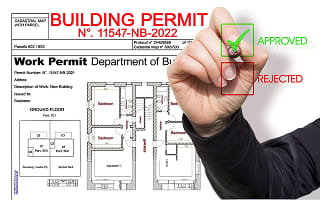
Most construction, renovation, remodeling, or building improvement projects in Peoria require a permit issued by the Peoria Development and Engineering Department. Cosmetic updates, such as painting, flooring, or cabinetry installation, as well as minor repairs, are generally exempt from permitting, as long as the work does not affect a building's structural integrity or core systems. You can use the city's development services online portal to submit permit applications, pay fees, and schedule required inspections. Note that first-time users must register an account to access the portal. You can also visit the department at 9875 North 85th Avenue, Peoria, AZ 85345, for in-person services or call its Development Services Center at (623) 773-7225 for questions and general assistance.
The types of permits available in Peoria include:
-
Building Permits: For new construction, structural additions, and major renovations.
-
Residential Building Permits: Issued for work on residential properties (one- and two-family dwellings, multi-family homes, custom homes, etc.)
-
Commercial Building Permits: Issued for work on non-residential properties.
-
-
Electrical Permits: For new circuit installations, service upgrades, rewiring, and other work that involves modifying or altering electrical systems.
-
Mechanical Permits: For installing or modifying furnaces, air conditioning units, ductwork, and other HVAC/mechanical systems.
-
Plumbing Permits: For water line modifications, sewer repairs, fixture relocations, and other work involving installing, repairing, or altering plumbing systems.
When applying for any of these permits, you must submit the proper documentation (building plans, blueprints, contractor licenses, materials lists, etc.). You must also pay the appropriate fee.
Building inspections are part of the permit process, and they ensure that the work complies with local building and safety codes. You can schedule an inspection through the online portal or in person at the office during regular business hours.
Real Estate in the City of Peoria
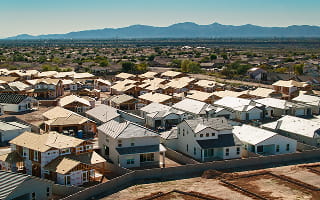
Peoria is one of Arizona's largest cities and a major suburb of Phoenix. Located in the West Valley of the Phoenix metro area, the city was originally established in the late 1880s as an agricultural community but has since evolved into a resort and leisure destination known for its high quality of life and natural Sonoran Desert beauty. Peoria is home to notable attractions, like Lake Pleasant Regional Park and the Peoria Sports Complex, which serves as the spring training home for the San Diego Padres and Seattle Mariners. It also hosts numerous annual events that attract tens of thousands of visitors each year.
Peoria, Arizona, has a population of 190,985 residents: a majority (approximately 98 - 99%) reside in the Maricopa County portion of the city and a very small percentage (about 1 - 2%) in the Yavapai County portion. The city has 80,681 housing units, with roughly 94% of these units occupied and 77% owner-occupied. There is a diverse housing stock that includes single-family and multi-family homes, condos, townhomes, retirement communities, and luxury homes. Common housing styles include Southwestern, Pueblo Revival, Ranch, Contemporary Desert, Spanish, Mediterranean, and Mid-Century Modern. The average home price in Peoria, AZ, is $481,220, representing a 2.5% decrease from previous years. Keep in mind that actual values may vary significantly depending on the neighborhood. Here are examples of average home prices for different neighborhoods across the city:
- Cibola Vista $505,699
- Florenza $839,646
- Pleasant Valley $838,871
- Tierra Del Rio $615,804
- Westwing Mountain $658,228
The Peoria, Arizona, real estate market is moderately competitive. There is increasing inventory, and properties sell relatively quickly, though prices have shown slight year-over-year declines. On average, homes go under contract within 44 days of listing, and approximately 13% of listed homes sell above their initial asking price.
Searching across multiple government offices and databases to piece together a complete property profile can be time-consuming, but PropertyChecker simplifies the process by pulling key ownership details, tax records, transaction histories, and more into a single, easy-to-use platform. Whether you are buying, investing, or simply doing your due diligence, visit PropertyChecker.com to get the property information you need in minutes.